
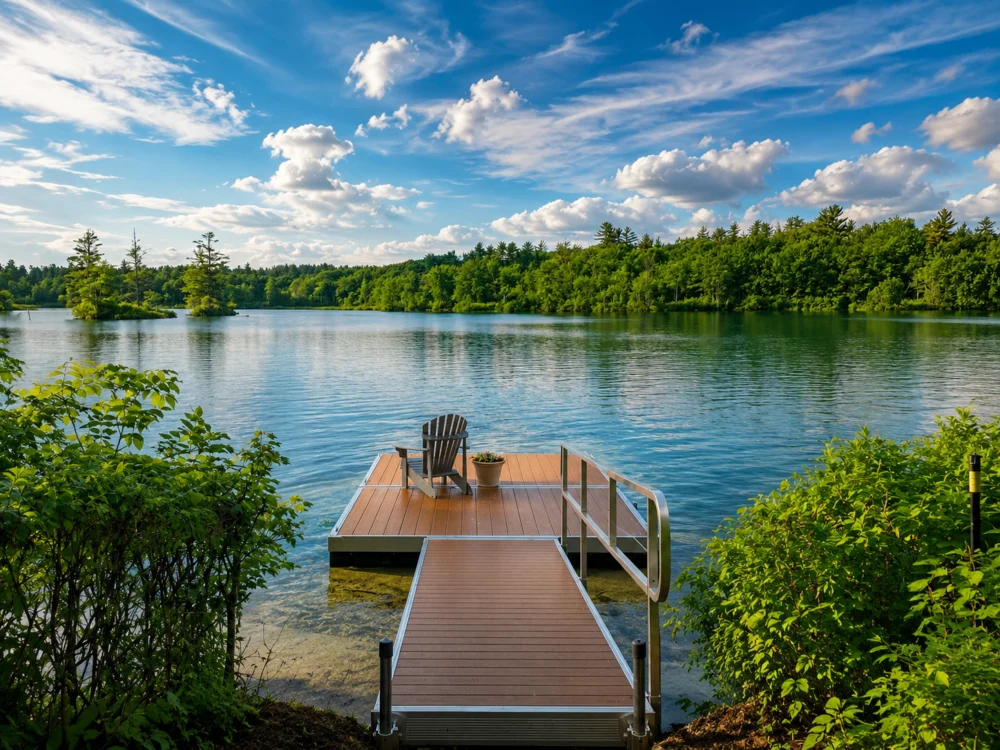
“Composite decking” sounds like one clearly defined material.
It isn’t.
The term describes an entire category of manufactured deck boards, and the products within that category can differ significantly. Some contain wood flour. Some depend on an outer cap for protection. Others are made without wood fiber altogether.
Those differences affect how a board responds to water, weather, insects and daily use. That is why comparing composite decking by color and price alone can leave out the most important question:
What is actually inside the board?
What Is Composite Decking Made Of?
A composite is simply a material created by combining two or more components. In decking, those components vary by manufacturer and product line.
Most manufactured decking falls into a few broad categories.
Wood-Plastic Composite Decking
Wood-plastic composite, commonly called WPC, combines plastic with wood flour, sawdust or other wood fibers. Many WPC boards include a polymer cap designed to help protect the core from moisture, stains and weathering.
These products generally require less maintenance than traditional wood and do not need to be stained and sealed in the same way. However, the composition still includes organic wood material.
PVC Decking
PVC decking is made primarily from polyvinyl chloride rather than a wood-plastic blend. It contains no wood fiber and is designed to resist moisture and decay.
PVC boards are available in numerous colors and surface treatments, although their appearance, weight and performance characteristics differ from both wood-plastic composite and HDPE-based lumber.
Mineral-Filled HDPE Composite Lumber
Lumberock Classic is manufactured from high-density polyethylene—HDPE—combined with inorganic mineral fillers.
It contains no wood fiber and no organic filler.
Instead of depending on a thin surface layer to keep moisture away from an organic core, Lumberock’s waterproof performance comes from the composition of the material itself. The result is solid, durable composite lumber designed for demanding outdoor environments.
Why Does Wood Fiber Matter?
Wood is naturally affected by its environment.
When exposed to water, humidity and changing temperatures, unprotected wood can swell, shrink, warp, split or rot. Paint, stain and sealant can slow that process, but they require continued maintenance.
Wood-plastic composite and natural wood are not equivalent. A manufactured composite can offer considerably better resistance to outdoor conditions than untreated lumber. But a composite containing wood fiber is still fundamentally different from a material made without any organic filler.
This distinction becomes especially important in places where moisture is not an occasional event.
Think about:
- Uncovered backyard decks
- Rainy and humid climates
- Poolside surfaces
- Docks and waterfront spaces
- Boardwalks and nature trails
- Areas exposed to sprinklers or standing moisture
- Commercial spaces that cannot be frequently refinished
When water is part of the setting, the board’s internal composition deserves more attention than the word “composite” printed on the label.
Capped Is Not the Same as Solid
Many composite deck boards use a protective cap around an internal core. Depending on the product, that cap may cover three sides, four sides or the exposed surface.
A quality capped board can provide strong resistance to stains, moisture and fading. But capped construction and solid construction are not the same thing.
Lumberock’s color and material run throughout the board. It is not a wood-based core protected by a separate capstock. This solid construction also allows Lumberock to offer substantial dimensional profiles for more than conventional deck surfaces.
The distinction is especially useful when a project calls for 2×6, 2×8, 2×4, 4×4 or other plastic-lumber profiles—not simply a standard capped deck board.
Compare More Than Colors
Color matters. Texture matters. The board should complement the home and help create the atmosphere you want outside.
But appearance is only the beginning of a responsible decking comparison.
Before choosing a product, ask:
- Does the board contain wood fiber or another organic filler?
- Is its moisture resistance provided by a cap or by the entire material?
- Does it require painting, staining or sealing?
- Is the color limited to the surface or present throughout the board?
- What profiles and lengths are available?
- What joist spacing and installation requirements apply?
- Is the product appropriate for the intended application?
- What warranty supports it?
These questions reveal far more than a sample viewed under showroom lighting.
Why Lumberock Classic Is Different
Lumberock Classic combines HDPE with inorganic mineral fillers to create waterproof composite lumber with no wood fiber or organic filler.
It resists rot, mold, mildew and insect damage. It will not splinter and does not need to be painted, stained or sealed. Classic is also available in 12 different profiles, allowing the collection to support backyard decks, docks, boardwalks, railings and other outdoor applications.
That versatility comes from treating the material as lumber—not merely as a decorative surface.
“Composite” Is the Beginning of the Conversation
There is no single best decking material for every project, climate, budget or design. Wood, wood-plastic composite, PVC and mineral-filled HDPE products each have distinct characteristics.
The mistake is assuming that every manufactured deck board offers the same construction or performance simply because it is called composite.
Look past the category. Look inside the board.
Because when a material will spend its life outside, what it is made from matters.
Frequently Asked Questions
Does all composite decking contain wood?
No. Many wood-plastic composite products contain wood flour or wood fibers, but other products are manufactured without wood. Lumberock contains no wood fiber or organic filler.
What is Lumberock Classic made from?
Lumberock Classic is manufactured from high-density polyethylene and inorganic mineral fillers.
Is Lumberock capped?
Lumberock is a solid, mineral-filled HDPE material. It does not rely on a separate protective cap over a wood-based core.
Is wood-free composite decking waterproof?
Performance varies by product. Lumberock’s material is waterproof because its HDPE and inorganic mineral composition does not absorb water like wood or wood-fiber materials.
Does Lumberock Classic require sealing?
No. Lumberock Classic does not require painting, staining or sealing.
See and feel the material difference for yourself. Explore the Lumberock Classic Collection or request a sample for your next outdoor project.