
A backyard deck may encounter rain.
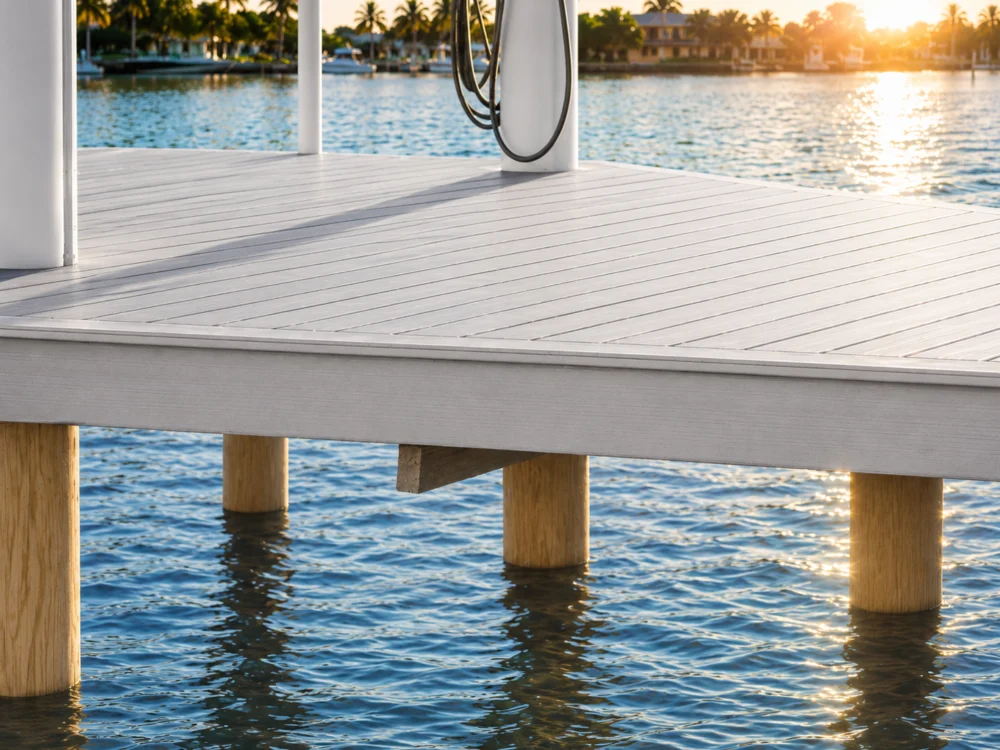
A dock lives with water.
It is exposed to waves, spray, wet feet, dripping equipment and moisture rising from below. Storms may temporarily raise the water above the deck surface, while floating sections and swim platforms can experience regular contact with the water.
Yet many docks are still built from materials that must be continually protected from getting wet.
That raises an obvious question: Why fight the environment when you can choose dock decking designed for it?
What Makes Dock Decking Different?
A dock is not simply a backyard deck placed beside a lake.
Waterfront environments create a more demanding combination of conditions:
-
Constant moisture and humidity
-
Splashing from above and below
-
Periodic flooding or submersion
-
Direct sun and reflected sunlight
-
Wet foot traffic
-
Fishing equipment, coolers and boat gear
-
Freshwater or saltwater exposure
-
Limited access for maintenance and repairs
The best decking for a dock should be evaluated for this environment—not selected solely because it performs well on a covered residential deck.
Most importantly, homeowners should determine whether the manufacturer actually approves the product for marine applications and water contact.
Waterproof Is Different From Water-Resistant
“Water-resistant” and “waterproof” are often treated as interchangeable terms. For dock decking, the distinction matters.
A water-resistant surface may be designed to repel occasional spills or rain. That does not automatically mean the entire board can withstand prolonged water exposure or submersion.
Lumberock Marine Grade Decking is made from high-density polyethylene and inorganic mineral fillers. It contains no wood fiber, no fiberglass and no organic filler. The result is a solid, nonporous material that is waterproof throughout the board.
Lumberock can be submerged in water indefinitely and is suitable for both freshwater and saltwater applications.
That capability changes the conversation from keeping water away from the decking to choosing decking that is fundamentally unaffected by water absorption.
Why Wood Fiber Matters Around Water
Natural wood can create a beautiful dock, but it requires protection from the same water that defines the setting.
When wood repeatedly absorbs and releases moisture, it can swell, shrink, crack, warp or rot. Paints, stains and sealers help protect it, but waterfront exposure can make that maintenance cycle particularly demanding.
Many conventional composite boards contain wood flour or wood fibers. Those products are not the same as natural lumber, and protective caps can improve moisture resistance considerably. However, not every composite product is approved for submersion or direct water contact.
Lumberock removes wood fiber from the board entirely.
Its mineral-filled HDPE composition does not need to be painted, stained or sealed, and it resists rot, mold, mildew and insect damage.
Less Dock Maintenance. More Time on the Water.
Dock maintenance is rarely convenient.
Furniture, ladders, cleats and equipment may need to be moved. Sections can be difficult to reach from land. Work may have to be coordinated around weather, water levels and boating season.
Lumberock eliminates the recurring need to sand, stain, paint or seal the deck boards. Routine care generally involves periodic cleaning appropriate for the conditions and following Lumberock’s published care guidance.
The dock still needs to be inspected. Fasteners, framing, flotation systems, railings and other structural components remain essential and may have different maintenance requirements.
Low-maintenance decking does not eliminate responsible dock ownership. It removes one of its most repetitive jobs.
Designed for More Than One Kind of Waterfront
Marine-grade decking can support a wide range of appropriately designed applications, including:
-
Residential docks
-
Fixed and floating docks
-
Piers
-
Boathouses
-
Swim platforms
-
Gangways
-
Pool decks
-
Marinas
-
Boardwalks
-
Gazebos and waterfront gathering areas
Lumberock is available in multiple profiles and 12 colors, helping waterfront owners create a coordinated space that complements the property instead of looking purely industrial.
Always confirm that the selected profile, framing, fasteners and installation method are appropriate for the project. Local building codes, environmental regulations and engineering requirements may also apply.
Questions to Ask Before Choosing Dock Decking
Before purchasing any decking for a marine application, ask:
-
Is the product approved for freshwater and saltwater use?
-
Can it be submerged?
-
Is the entire board waterproof or only its outer surface?
-
Does it contain wood fiber or organic filler?
-
Will it require staining, painting or sealing?
-
What framing and joist spacing are required?
-
Which fasteners are recommended for the environment?
-
Does the warranty cover the intended marine application?
A dock is too significant an investment to build around vague assumptions.
Build for the Water—Not Against It
The water is not going anywhere.
Your dock material should be selected with that reality in mind.
Lumberock Marine Grade Decking is waterproof, fully submersible and approved for freshwater and saltwater environments. It contains no wood fiber or organic filler and will not rot, crack, warp or splinter.
It gives waterfront owners a dock surface designed to spend its life exactly where they want to be:
On the water.
Frequently Asked Questions
Can Lumberock be submerged in water?
Yes. Lumberock Marine Grade Decking is waterproof and can be submerged in water indefinitely.
Can Lumberock be used in saltwater?
Yes. Lumberock is approved for both freshwater and saltwater applications.
Does Lumberock contain wood fiber?
No. Lumberock is manufactured from HDPE and inorganic mineral fillers. It contains no wood fiber or organic filler.
Does marine-grade decking need to be sealed?
Lumberock does not require painting, staining or sealing.
Can Lumberock be used on floating docks?
Lumberock can be used as decking for appropriately designed floating dock applications. The complete system—including framing, flotation, fasteners and load requirements—must be properly designed and installed.
Planning a dock, pier or waterfront retreat? Explore Lumberock Marine Grade Decking or request samples for your project.