
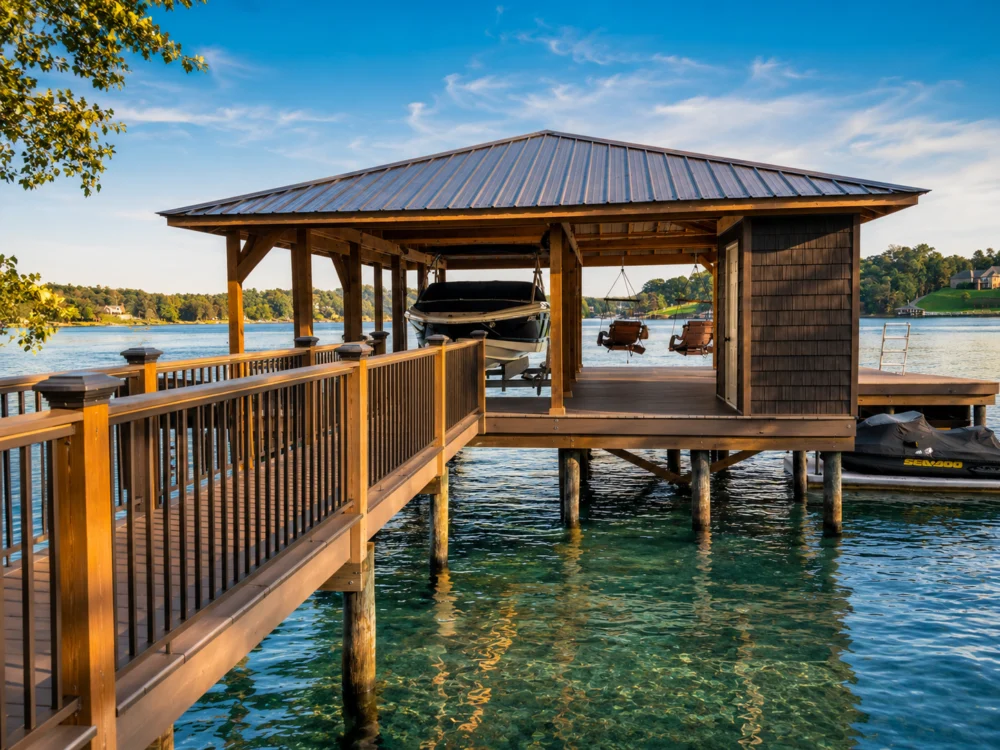
A quiet freshwater lake and an exposed coastal marina may look like completely different environments.
To an unsuitable deck board, they share one important characteristic:
They are both wet.
Freshwater docks contend with rain, humidity, changing water levels, algae, organic debris and seasonal weather. Saltwater docks add salt spray, tides, coastal storms and a highly corrosive environment for hardware and structural components.
The location changes. The need for waterproof dock decking does not.
Freshwater Is Not a Mild Environment
Freshwater may sound less demanding than saltwater, but lake and river docks experience relentless moisture exposure.
Boards may remain shaded and damp for long periods. Leaves, pollen and other organic debris can collect on the surface. Water levels may rise during storms, occasionally covering sections that normally sit above the waterline.
Floating docks move with the water and can experience repeated splashing from below. Swim platforms receive wet foot traffic throughout the day.
Wood decking in these conditions must be consistently maintained to help protect it against water absorption, rot, mold, mildew and insects.
A freshwater setting may be peaceful. It is not necessarily easy on outdoor building materials.
Saltwater Adds Another Layer of Demand
Coastal docks, piers and marinas face many of the same moisture challenges, with salt added to the environment.
Salt spray can reach surfaces that rarely touch the water directly. Tidal changes may expose different sections of the structure, and coastal storms can bring flooding, wind-driven rain and debris.
Hardware selection becomes particularly important because saltwater can accelerate corrosion in incompatible metals. Fasteners, connectors and structural components must be chosen for the specific environment and installed according to applicable requirements.
Decking material is only one part of a successful coastal system—but it is a part that should not be vulnerable to water absorption.
One Waterproof Material for Both Environments
Lumberock Marine Grade Decking is approved for freshwater and saltwater applications.
It is manufactured from high-density polyethylene combined with inorganic mineral fillers. The solid material contains no wood fiber, fiberglass or organic filler and is waterproof throughout the board.
Lumberock can even remain submerged in water indefinitely.
This makes it a versatile surface material for residential docks, marinas, piers, swim platforms, gangways, boardwalks and other appropriately designed waterfront applications.
Instead of using one product for the residential deck and searching for a different material near the water, property owners can create a coordinated design using a material built for both.
Do Not Confuse a Protective Surface With a Waterproof Board
Some manufactured deck boards depend on an exterior cap to help protect an internal core. These products can perform well in many outdoor environments, but not every capped board is approved for direct water contact or submersion.
Cut ends, fastener penetrations and installation details can become particularly important when the core contains wood fiber.
Lumberock does not contain a wood-based core. Its marine performance comes from the material composition itself rather than a separate surface treatment.
That does not make installation details optional. Proper spacing, fastening, framing and ventilation requirements must still be followed.
A waterproof board must be part of a correctly designed system.
The Material Should Match the Entire Waterfront Lifestyle
A dock rarely exists by itself.
Waterfront properties may also include:
-
A boathouse
-
Gangways and access ramps
-
A swim platform
-
A pool or waterside gathering area
-
Walkways between the home and dock
-
Benches or seating areas
-
Railings and gates
-
Fish-cleaning or equipment areas
Lumberock is available in multiple board profiles and 12 colors, allowing designers to create a more unified waterfront environment.
The material resists stains and fading and will not rot, crack, warp or splinter. It also requires no painting, staining or sealing.
That means fewer recurring maintenance projects competing with boating, fishing, swimming and everything else that brought you to the water.
What Still Changes Between Freshwater and Saltwater?
A versatile decking material does not make freshwater and saltwater construction identical.
Project professionals must still account for:
-
Corrosion-resistant fasteners and connectors
-
Wave, wind and uplift forces
-
Tides and changing water levels
-
Floating versus fixed construction
-
Local permitting requirements
-
Environmental restrictions
-
Structural loads and intended occupancy
-
Freeze-and-thaw conditions where applicable
-
Required accessibility and safety features
The decking may be ready for either environment. The full dock must be designed for the specific site.
Choose for the Conditions You Cannot Control
You cannot stop a lake from rising after heavy rain. You cannot prevent salt spray from reaching a coastal pier. You cannot guarantee that every section of a dock will remain dry.
You can choose a decking material that does not need those guarantees.
Lumberock Marine Grade Decking is waterproof, fully submersible and approved for both freshwater and saltwater applications. With no wood fiber or organic filler, it is designed to face waterfront conditions without the recurring painting, staining and sealing required by wood.
Freshwater or saltwater, the principle is the same:
Build for the environment you have.
Frequently Asked Questions
Is Lumberock suitable for freshwater docks?
Yes. Lumberock Marine Grade Decking is approved for freshwater applications, including appropriately designed docks, piers and swim platforms.
Can Lumberock be used near saltwater?
Yes. Lumberock is approved for saltwater applications.
Will saltwater damage Lumberock decking?
Lumberock’s solid HDPE and inorganic mineral composition is waterproof and designed for harsh marine environments. The surrounding fasteners, connectors and substructure must also be properly specified for saltwater exposure.
Can Lumberock be fully submerged?
Yes. Lumberock can remain submerged in water indefinitely.
Is marine-grade decking structural?
Decking and structural support are different project considerations. Never assume a deck board can replace structural framing. Use the appropriate Lumberock profile only as permitted by its specifications and follow engineered plans, manufacturer instructions and applicable codes.
Whether your view includes a quiet lake or an open coastline, Lumberock can help you build a waterfront space made for the water. Explore Marine Grade Decking or request a sample.