
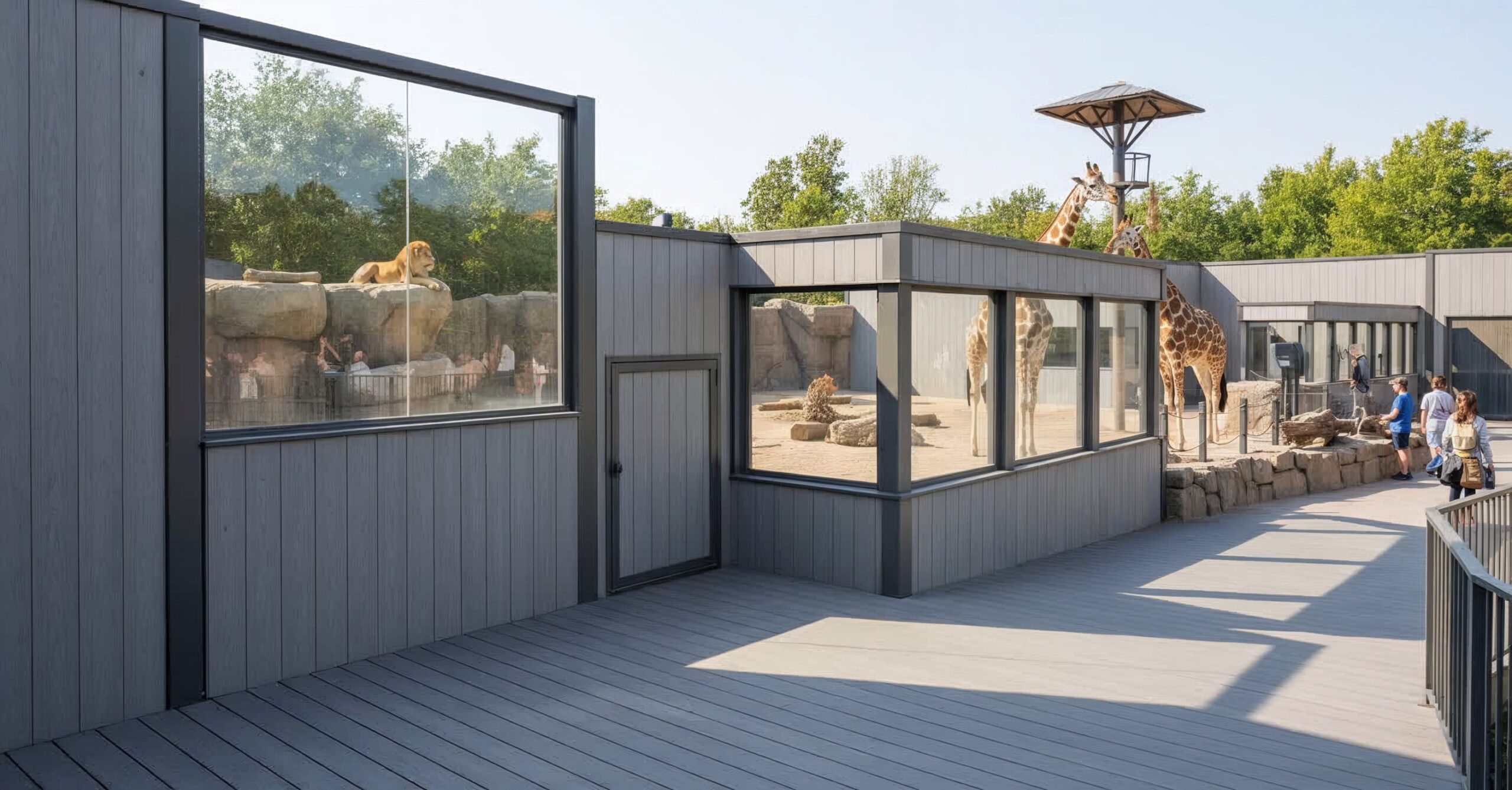
Zoo and aquarium environments are designed around living creatures.
The building materials still have to survive everything that comes with them.
Water, waste, food, bedding, humidity, cleaning and heavy visitor traffic can place extraordinary demands on an enclosure or public-facing space. Materials may be wet repeatedly, cleaned frequently and exposed to indoor and outdoor conditions within the same facility.
Natural wood can add warmth to an environment, but it also introduces pores, splinters, organic material and recurring refinishing needs.
In places built around animals, material selection deserves a more demanding standard.
Animal Environments Are Not Ordinary Commercial Spaces
A board in an animal environment may encounter:
-
Constant humidity
-
Repeated washdowns
-
Splashing or standing water
-
Animal waste
-
Food and organic debris
-
Claws, hooves, beaks or teeth
-
Cleaning products
-
Heavy public traffic
-
Indoor and outdoor exposure
-
Limited maintenance windows
A material that performs well in a retail space or backyard may not be suitable for these conditions.
Zoos and aquariums must also consider the specific behavior and welfare needs of each species. A material appropriate for a visitor boardwalk may not be appropriate inside an animal enclosure. A component used around a freshwater exhibit may have different requirements from one exposed to saltwater or aggressive cleaning.
There is no universal animal-environment material.
There are, however, material characteristics that can solve recurring problems.
Stop Asking Porous Materials to Behave Like Nonporous Ones
Wood is organic and porous. It can absorb moisture unless it is continuously protected.
In an environment that requires frequent cleaning, the protective finish may become an ongoing maintenance concern. Cracks, joints and damaged areas can retain moisture and debris, while weathered wood can form rough edges and splinters.
Lumberock Artisan is made from HDPE and inorganic mineral fillers. It contains no wood fiber or organic filler and is waterproof throughout the board.
Its nonabsorbent composition makes it well suited for consideration in spaces where water and cleaning are routine. It also resists rot, mold, mildew and insect damage and does not require painting, staining or sealing.
This does not make any material automatically hygienic or appropriate for every species. It creates a more practical starting point for applications where porous wood presents a recurring challenge.
One Facility, Many Possible Applications
Zoos, aquariums, wildlife centers, kennels and animal-care facilities contain far more than the enclosures visitors see.
Potential Artisan applications may include:
-
Visitor decking and walkways
-
Boardwalks through outdoor habitats
-
Viewing platforms
-
Animal enclosure components
-
Gates and partitions
-
Back-of-house work areas
-
Wash-area components
-
Benches and picnic tables
-
Fencing
-
Signage supports
-
Equipment-area protection
-
Storage and material-handling components
The suitability of the material must be evaluated independently for each use.
Public walking surfaces require appropriate structural design, fastening, accessibility and slip-performance evaluation. Animal-contact applications require review based on the species, anticipated behavior, cleaning protocol and veterinary guidance.
Aquarium environments may also require evaluation for constant humidity, salt exposure, submersion and compatibility with exhibit systems.
Splinters Are More Than a Cosmetic Problem
Weathered wood can become rough, cracked or splintered.
In a public area, splinters can affect visitors who touch railings, benches or other surfaces. Inside an animal environment, rough edges may create an additional concern for animals rubbing against or interacting with the material.
Artisan will not splinter like natural wood.
That makes it useful for designers exploring materials for high-contact environments. It does not eliminate the need for rounded edges, protected fasteners, appropriate clearances or regular inspections.
A splinter-free material still needs thoughtful detailing.
Customization Without Returning to Wood
Animal facilities often require unusual shapes, dimensions and colors.
An enclosure may need a particular board thickness. A visitor space may need colors that blend into the surrounding habitat. A zoo or aquarium may want furnishings and barriers that coordinate with an established visual identity.
Artisan is available in multiple standard board and tongue-and-groove profiles, 12 standard colors and additional custom colors. Custom shapes, sizes and specialized applications may also be available.
This flexibility gives designers an alternative to forcing ordinary residential products into highly specialized spaces.
Maintenance Can Affect the Entire Facility
Maintenance inside an animal environment is more complicated than repairing an ordinary commercial space.
Animals may need to be temporarily relocated. Public areas may need to close. Work must be coordinated with animal-care teams, veterinarians, operations staff and visitor schedules.
Choosing a material that does not rot and does not require painting, staining or sealing can reduce several recurring maintenance demands.
Artisan still needs appropriate cleaning. Fasteners, supports and surrounding components still require inspection. Damaged material must be addressed promptly.
The goal is not to eliminate maintenance. It is to stop creating unnecessary maintenance with the wrong material.
Let the Application Make the Decision
Before specifying plastic lumber in an animal environment, ask:
-
Will animals have direct access to the material?
-
Could the species chew, claw, kick or ingest damaged components?
-
Which cleaning products and temperatures will be used?
-
Will the material be submerged or exposed to saltwater?
-
Are there required fire, structural or accessibility ratings?
-
How will edges and fasteners be protected?
-
What expansion and contraction must the design accommodate?
-
Has the application been reviewed by the facility’s animal-care and design professionals?
The correct material is the one that meets the complete application—not merely the one with the strongest marketing claim.
Lumberock Artisan offers a waterproof, nonabsorbent and customizable material platform for animal environments that demand more from every component.
Because animals do not care whether maintenance is convenient.
The material still has to perform.
Frequently Asked Questions
Can Artisan be used in zoo animal enclosures?
Artisan can be considered for appropriately designed animal enclosures. Suitability must be evaluated for the species, expected contact, enclosure design, cleaning protocol and applicable facility requirements.
Can Artisan be used around aquariums?
Its waterproof HDPE and mineral-filled composition makes Artisan suitable for consideration in humid and water-exposed environments. Confirm the requirements of the specific exhibit, including saltwater exposure, submersion and animal contact.
Is Artisan easy to clean?
Artisan is nonabsorbent and does not require a protective stain or sealer. Cleaning methods and products should follow Lumberock guidance and the facility’s approved sanitation protocol.
Will Artisan rot or splinter?
No. Artisan resists rot and will not produce wood splinters.
Can colors and profiles be customized?
Yes. Artisan is available in standard and custom colors, shapes and sizes, subject to manufacturing requirements and minimum quantities.
Designing an animal enclosure, aquarium environment or public wildlife facility? Contact Lumberock to evaluate Artisan for your specific application.