
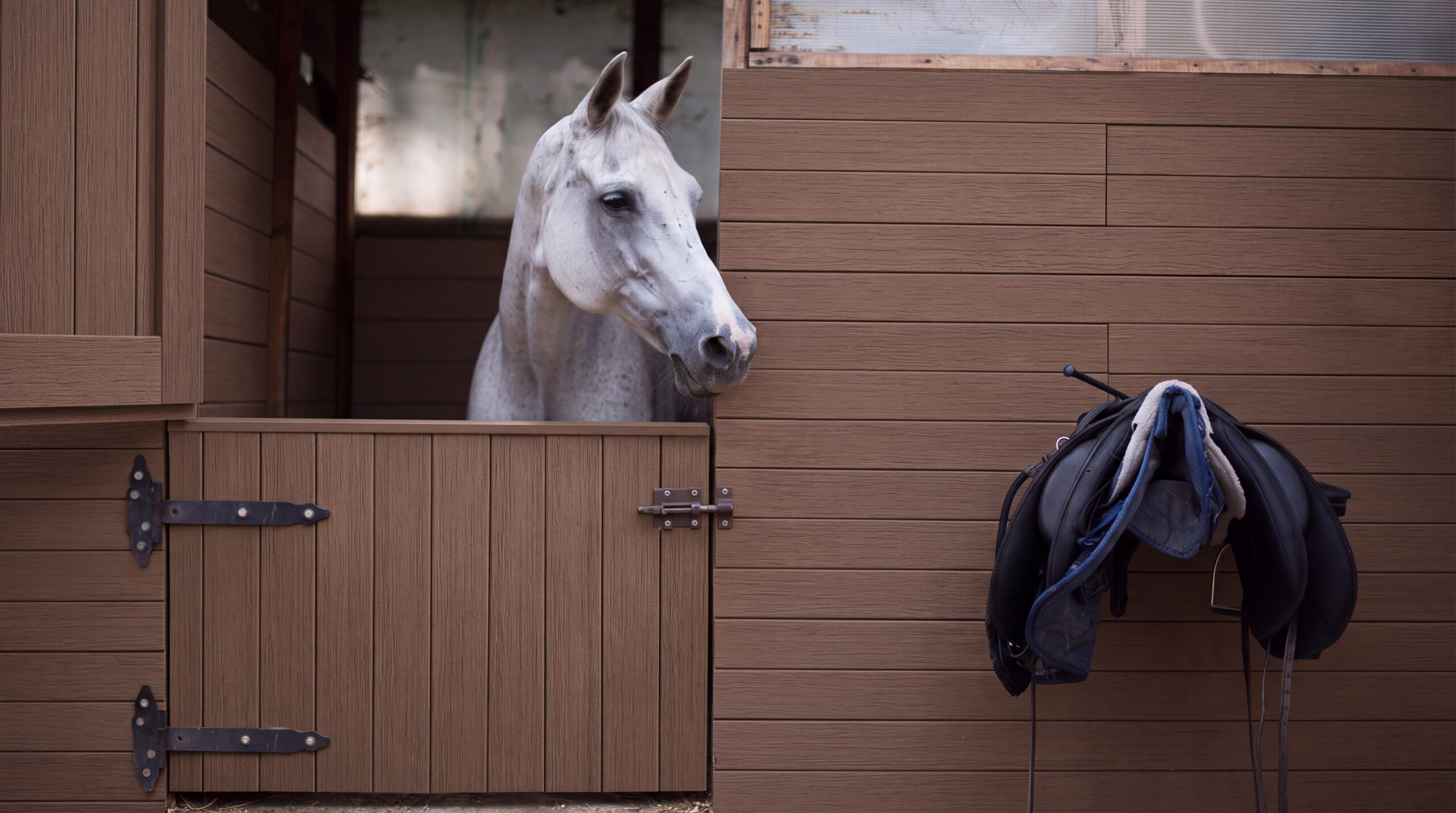
A horse stall is not a decorative space.
Its walls encounter moisture, mud, bedding, cleaning, chewing, kicking and the daily force of an animal that can weigh more than half a ton. Materials that perform adequately in an ordinary building may deteriorate much faster inside an active equestrian facility.
Wood has traditionally been the default choice because it is familiar, accessible and easy to work with.
But familiar does not always mean best suited to the environment.
For stall walls, kickboards, fencing components and other appropriate equestrian applications, plastic lumber can provide a durable alternative without the splinters, rot and recurring maintenance associated with wood.
Horse Stalls Are Demanding Environments
Moisture enters a stable in more ways than one.
Rain and humidity affect exterior areas. Water buckets spill. Floors and lower walls are washed. Urine, mud and wet bedding create additional exposure inside the stall.
Wood can absorb that moisture. Over time, repeated exposure may contribute to swelling, splitting, rot, mold and mildew. Surface treatments can offer protection, but heavily used areas are difficult to keep perfectly sealed.
Then there is the horse.
Horses may rub against, lean into, kick or chew stall boards. Damaged wood can develop rough edges and splinters, while severely compromised boards may require replacement.
A stall material should be selected for all of these conditions—not merely for how it looks when the facility opens.
Waterproof From the Inside Out
Lumberock Artisan is manufactured from high-density polyethylene and inorganic mineral fillers.
It contains no wood fiber or organic filler. Its solid, nonabsorbent composition is waterproof throughout the board rather than dependent on paint, stain or another surface treatment.
That makes Artisan especially useful in environments where moisture is a routine part of daily operations.
The boards resist rot, mold, mildew and insect damage. They do not require painting, staining or sealing and will not splinter like natural wood.
For barn owners and facility managers, that can mean less time repairing stall surfaces and more confidence in the material surrounding the animals.
A Safer Surface Begins With Fewer Splinters
No single material can make an animal enclosure completely injury-proof. Horses are powerful, unpredictable animals, and every stall must be properly designed and inspected.
However, eliminating splintered wood removes one familiar concern.
Lumberock Artisan is tough enough to resist chewing and everyday damage while providing a solid surface that will not produce wood splinters. Its nonabsorbent composition also supports easier cleaning than porous wood.
The stall still requires routine cleaning and inspection. Boards, channels, fasteners, doors and connections should all be checked for damage or movement.
Durability does not replace good animal-care practices. It helps support them.
Designed for Heavy, Repetitive Use
Equestrian facilities experience a type of wear that residential materials rarely encounter.
Stalls are occupied, emptied, cleaned and occupied again. Equipment repeatedly passes through aisles. Doors, partitions and lower wall sections receive constant contact.
Lumberock Artisan was developed for demanding commercial and industrial applications. Its HDPE and mineral-filled construction provides a durable, low-maintenance material for properly designed animal stalls and enclosures.
Potential equestrian applications may include:
-
Stall wall boards
-
Kickboards
-
Wash-area components
-
Fencing and partitions
-
Gates and door components
-
Equipment-area protection
-
Arena and facility furnishings
The specific profile, thickness, support system and fastening method must be selected for the intended use and anticipated loads.
Low Maintenance Matters in a Working Barn
Barn maintenance never really stops.
There are fences to inspect, stalls to clean, equipment to repair and animals to care for. Repainting, resealing and replacing deteriorated wood adds another recurring task.
Lumberock Artisan requires no painting, staining or sealing. Because the material is waterproof and nonabsorbent, it does not need a protective finish to prevent moisture from entering the board.
That does not make it maintenance-free. Surfaces still require cleaning, and the entire stall system must be routinely inspected.
It does remove the refinishing cycle that comes with traditional wood.
Profiles That Work With the Design
Artisan is available in standard boards as well as tongue-and-groove profiles that can be useful for creating continuous stall walls.
Available options include 1×4, 1×6, 1×10, 2×4, 2×6, 2×8 and other profiles. Custom shapes, lengths and colors may also be available depending on project requirements and order quantities.
This flexibility helps manufacturers, barn builders and facility owners select material around the stall design rather than redesigning the entire project around one standard board.
Build the Stall for the Horse That Will Actually Use It
A quiet pony and a large, active horse may place very different demands on an enclosure.
Before selecting any stall material, consider:
-
Animal size and behavior
-
Potential chewing and kicking
-
Board thickness
-
Distance between supports
-
Fastener placement
-
Edge and corner protection
-
Required ventilation
-
Cleaning practices
-
Fire and building codes
-
Veterinary and facility-design guidance
Artisan should be used as part of a complete, properly designed enclosure system.
Because the right question is not simply, “What have horse stalls always been made from?”
It is, “What material makes sense for the conditions inside this stall?”
Frequently Asked Questions
Can plastic lumber be used for horse stalls?
Yes. Properly specified plastic lumber can be used for horse stall walls, kickboards and other equestrian applications. The complete enclosure must be designed for the animal, anticipated loads and applicable requirements.
Will Lumberock Artisan absorb water?
No. Artisan’s HDPE and inorganic mineral composition is waterproof and nonabsorbent.
Can horses chew Lumberock boards?
Artisan is tough and chew-resistant, but no enclosure material should be assumed to be indestructible. Every stall should be inspected regularly, particularly when housing animals known to chew or damage surfaces.
Does Artisan splinter?
No. Lumberock Artisan will not produce wood splinters.
Does it need to be painted or sealed?
No. Artisan does not require painting, staining or sealing.
Are tongue-and-groove stall boards available?
Yes. Artisan is available in several tongue-and-groove and standard board profiles. Confirm the appropriate profile and installation method for the stall design.
Building or upgrading an equestrian facility? Contact Lumberock to discuss Artisan profiles, colors and custom options for your horse stall application.